-
Blowing Agents

-
Blowing Agents
-
Blowing Agents
-
Blowing Agents
-
Blowing Agents
-
Blowing Agents
-
Blowing Agents
-
Blowing Agents
-
Blowing Agents

The blowing agents are chemical compounds added to manufacture sponge products. The additives are mixed with polymeric materials such as synthetic resins or rubbers to produce gas through thermal decomposition and produce foam structures. Chemical blowing agents are classified into two categories, i.e., inorganic and organic agents. The agents produced by Kumgang include agents for PVC, EVA, PE/PP, rubbers, and other blowing agents

Foams made using PVC (polyvinyl chloride) and a blowing agent are used to make pipe insulation, artificial leather, sandals, and PVC flooring and wall coverings
• CELLCOM - AC Series (Azodicarbonamide) As they have several advantages such as non-toxicity, high-temperature applications, and high foaming ratio, they are the most commonly used products for manufacturing plastics and rubber sponges and have a wide range of particle sizes according to the needs of users
• CELLCOM - SM Series (Modified Azodicarbonamide) As modified Azodicarbonamide products, they are products developed suitable for user needs such as increased whiteness, productivity improvement, or low-temperature process
• CELLCOM - OBSH Series (p,p-Oxybis benzene sulfonylhydrazide) Unlike AC and DPT, they are white-blowing agents with a low decomposition temperature and do not generate ammonia gas when decomposed. They are widely used for EPDM weatherstrip and high-quality PVC wallpaper that requires high whiteness
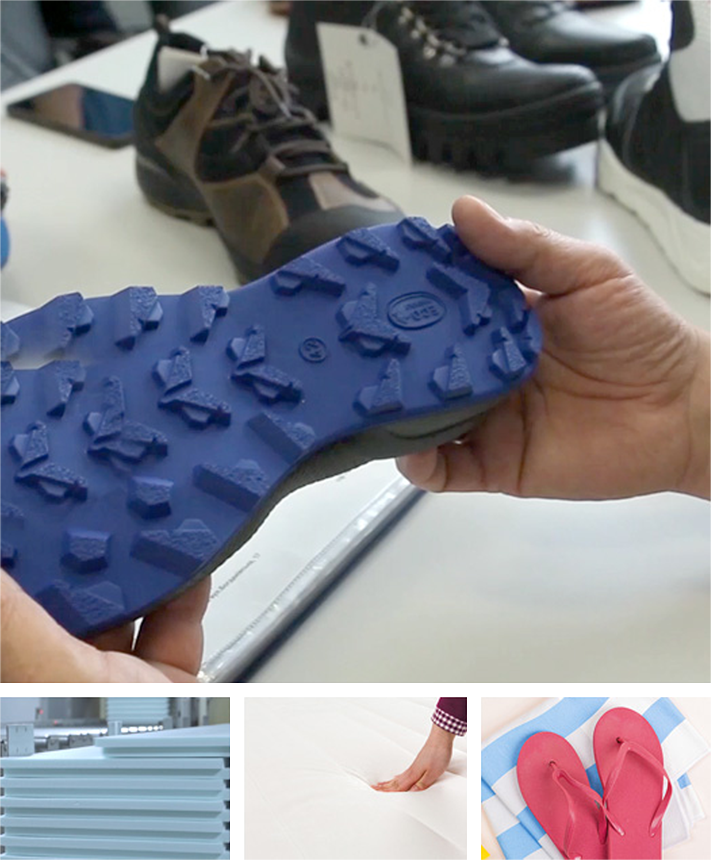
Foams made using EVA(Ethylene Vinyl Acetate) and a blowing agent are used to make sports shoes (Nike, Adidas, etc.), sandals, sound-insulating PVB interlayers, toys for young children, fishing tools, and other EVA sponges
• CELLCOM - JTR Series (Modified Azodicarbonamide) As our representative blowing agents for EVA, they significantly improve the physical properties of EVA sponges compared to other blowing agents
• CELLCOM - AC Series (Azodicarbonamide) As they have several advantages such as non-toxicity, high-temperature applications, and high foaming ratio, they are the most commonly used products for manufacturing plastics and rubber sponges and have a wide range of particle sizes according to the needs of users
• CELLCOM - SM Series (Modified Azodicarbonamide) As modified Azodicarbonamide products, they are products developed suitable for user needs such as increased whiteness, productivity improvement, or low-temperature process
• CELLCOM - ACP Series (Modified Azodicarbonamide) Rubber, PE, and EVA are relatively inexpensive products that are blowing agents applied under pressure
• CELLCOM - OBSH Series (p.p-Oxybis benzene sulfonylhydrazide) Unlike AC and DPT, they are white-blowing agents with low decomposition temperatures and do not generate ammonia gas when decomposed. They are products that are widely used for EPDM weatherstrip. The demand for the agents to use for formamide-free toys and EVA mats is increasing

Blowing Agents for PE/PP
Foams made using PE(Polyethylene) or PP(Polypropylene) and a blowing agent are used to make automotive door panels, pipe insulation, and mats
• CELLCOM - ACMP Series (Specially Azodicarbonamide) They are specialized products to be used for chemically cross-linked PE foam or electron beam cross-linked foam
• CELLCOM - AC Series (Azodicarbonamide) As it has many advantages during foaming, such as non-toxicity, high-temperature foaming properties, and high foaming ratio, it is the most universally used foaming agent for manufacturing plastics and rubber sponges and has a wide range of particle sizes according to the needs of users

Foams made using rubber such as EPDM(Ethylene Propylene Diene Monomer), NBR(Acrylonitrile-Butadiene Rubber), CR(Chloroprene Rubber) and a blowing agent are used to make EPDM weatherstrip, electric cable insulation, EPDM insulation, wetsuit, rubber sponge (EPDM, CR, SBR), etc.
• CELLCOM - OBSH Series (p,p-Oxybis benzene sulfonylhydrazide) Unlike AC and DPT, they are white-blowing agents with low decomposition temperatures and do not generate ammonia gas when decomposed. They are products that are widely used for EPDM weatherstrip and in special fields such as CR wetsuits
• CELLCOM - TSH Series (p-Toluene sulfonyl hydrazied) Like OBSH, the products are white-blowing agents with low decomposition temperatures, and suitable for vulcanization of rubber
• CELLCOM - ACP Series (Modified Azodicarbonamide) They are blowing agents applied when foaming under pressure, such as rubber, PE, and EVA, and relatively inexpensive products
• CELLCOM - AC Series (Azodicarbonamide) As they have several advantages such as non-toxicity, high-temperature applications, and high foaming ratio, they are the most commonly used products for manufacturing plastics and rubber sponges and have a wide range of particle sizes according to the needs of users
• CELLCOM - SM Series (Modified Azodicarbonamide) As modified Azodicarbonamide products, they are products developed suitable for user needs such as increased whiteness, productivity improvement, or low-temperature process

Foams made using other blowing agents are used to make doors, windows, frames, and cap seals
• CELLCOM - TSS Series (p-Toluenesulfonyl semicarbazide) Blowing agents with high decomposition temperatures are suitable for forming engineering plastics (ABS, PS, PP, etc.) with a high processing temperature. In particular, they are the advantage of being able to control conditions during extrusion processing of difficult-to-deform materials
• CELLCOM - 5PT (5-Phenyltetrazole) Blowing agents with an ultra-high decomposition temperature are suitable for engineering plastics (PC, Nylon, PET, etc.) with a very high processing temperature
• KYCEROL Series (Modified Sodium Bicarbonate) They are inorganic chemical blowing agents that cause an endothermic reaction when decomposed. They do not have toxicity and odor and have good flowability. They are used for preventing shrinkage in plastic injection molding and manufacturing cap seals